Content Editor
Understand the subject
Extract the entities, verbs, and linguistic patterns that give a subject its context.
Entities · verbs · contextExplore the entities, relationships, and evidence behind a subject. Create content with context and a connected structure you can inspect.



Explore four views of your subject: researched relationships, draft entities, audit findings, and structured data.

An industry connects to its services. Shared entities connect those services to one another. Select a node to inspect the relationship.
The industry connects to services extracted from provider pages.
Select an entity to explore its relationships and evidence.
Platform totals
Across PirateSERP accounts
Loading platform totals
Four connected tools. From understanding a subject to expressing its structure.
Extract the entities, verbs, and linguistic patterns that give a subject its context.
Entities · verbs · contextExplore how entities relate. Inspect the connections and the evidence behind them.
Entities → relationshipsReview coverage, relationships, and missing context against researched industry data.
Evidence → findingsConnect entities through schema.org properties validated for their source and target types.
Entities → validated JSON-LDA subject becomes an inventory of entities, actions, and context you can work with.

A single position captures one location. Your business can appear differently just a few streets away.
Explore the service area, point by point. See where visibility is strong and where to investigate next.
Explore GeoPin Generator →Loading grid totals
One location is only the beginning. Select a point to explore.
Research the subject. Explore its relationships. Create, validate, and observe with PirateSERP.
Turn subject research into a clearer draft.
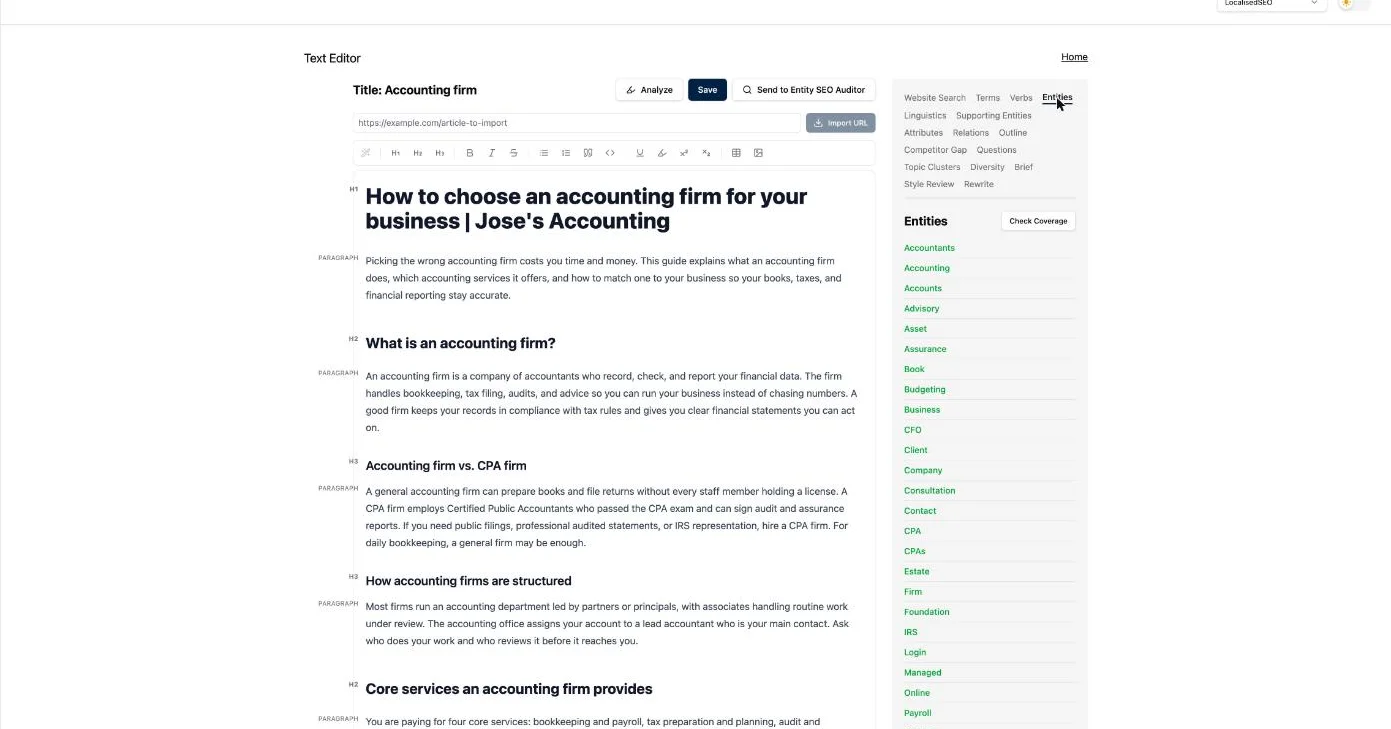
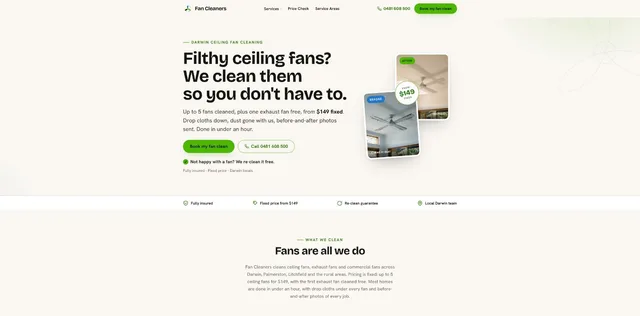
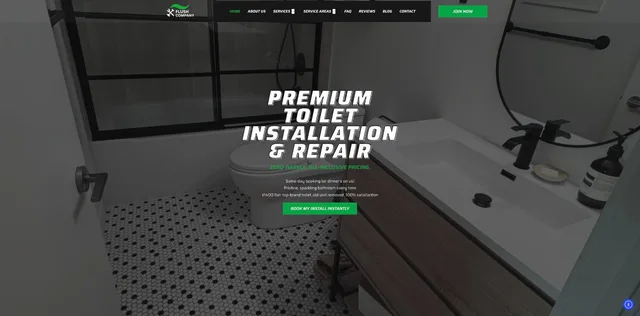
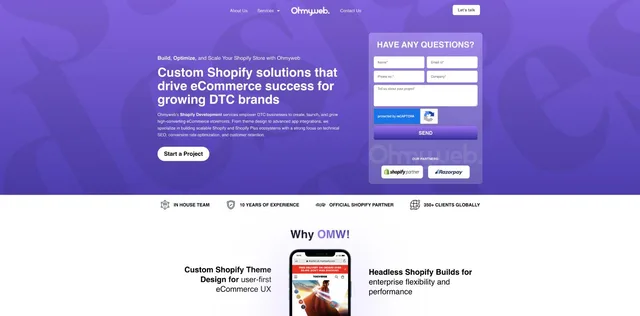
Actual product captures from PirateSERP accounts. Explore the work behind the tools.
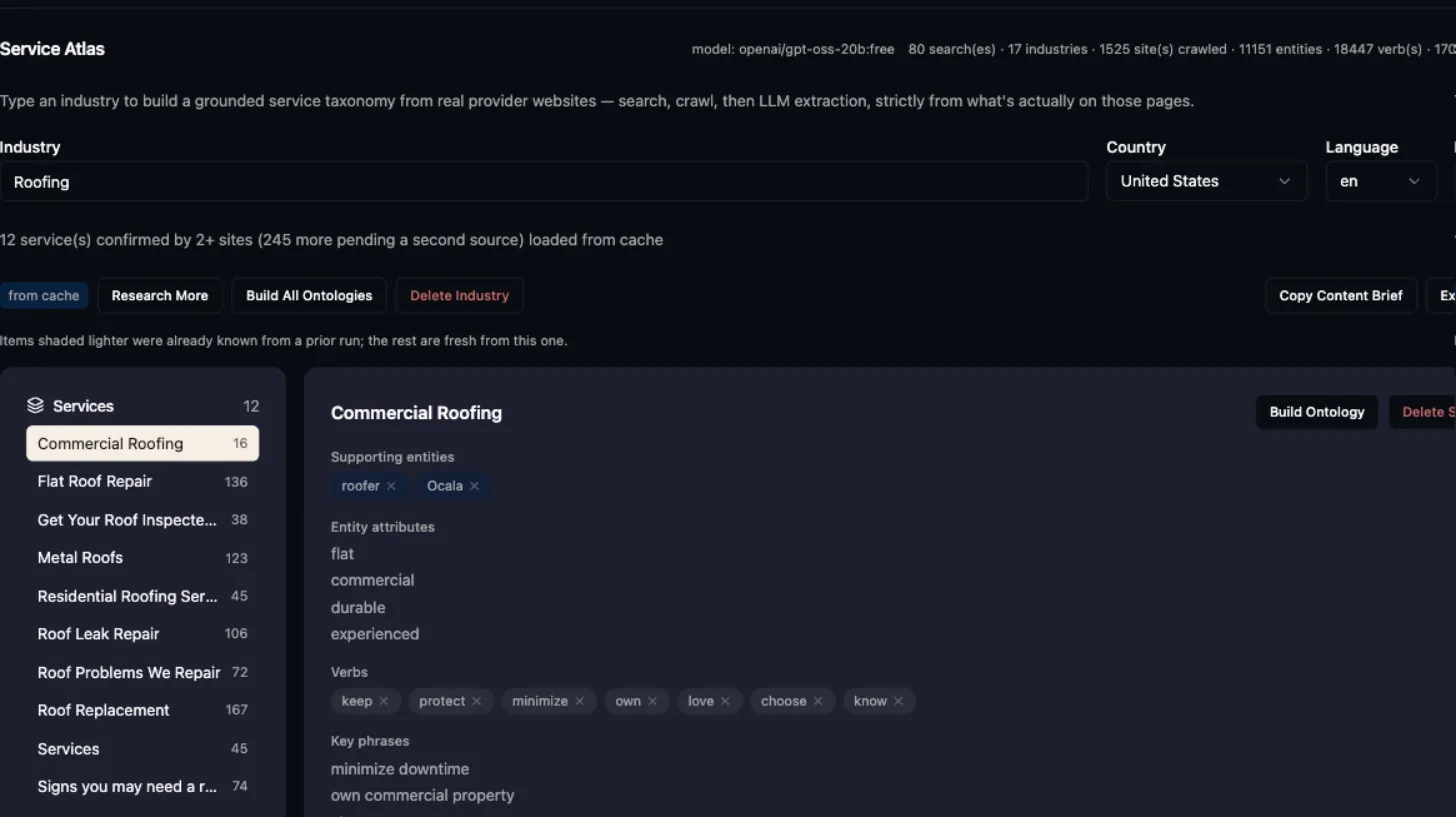
This roofing research mapped 12 confirmed services from 1,525 crawled sites. Inspect the taxonomy behind the subject.
PirateSERP combines entity research, content review, schema validation, and search visibility tools in one subscription. Your client projects share the same workspace.
Your subscription includes PirateSERP's tools and search engine results page (SERP) data. You do not need a separate DataForSEO subscription.
Extract services, entities, and relationships from provider pages. Inspect the source evidence.
Check semantic coverage and alignment. Review proposed changes before applying a rewrite.
Build schema.org connections that accept the source and target entity types.
Track search positions, inspect local results, and review technical findings across client sites.
Select a project to access its drafts, audits, and schema workspace. Continue the work without reconstructing the subject in every tool.
Check setup requirements, content controls, and subscription details before you start.
Create an account and subscribe. Search data is included, so you do not need a DataForSEO account.
For AI-assisted work, add an OpenRouter key in Account Settings and select a supported model. Content Alignment also requires a Google Gemini key. Analytics connections require credentials for the services you connect.
Your AI providers bill usage separately. Charges depend on the model and the work you run.
Some optional tools require other provider accounts. Business Search, for example, uses your Google Maps Places API key. PirateSERP does not mark up provider usage.
You can start with a subject, a saved draft, or a page URL. PirateSERP presents extracted entities, relationships, and findings for you to inspect.
You still need to understand your subject and review the evidence. An entity appearing in competitor content does not automatically make it relevant to yours.
Yes. Entity SEO Auditor, Content Alignment, and E-E-A-T Analysis accept saved Content Editor drafts.
You can review semantic coverage, alignment, and content quality before publishing. Checks that inspect live pages, including technical crawling and internal links, require a published URL.
The audit-to-editor workflow presents a rewrite for review. It replaces your draft only after you select Apply rewrite.
Some editor actions change content directly. Create in the Outline tab replaces the draft, and the selection rewrite changes highlighted text. These actions require your input.
The documented content workflow leaves publishing to you.
The audit identifies the gap. Its rewrite workflow leaves findings that require missing information for you to address.
Add the facts and supporting evidence, then audit the draft again. A rewrite does not establish facts about your business.
PirateSERP extracts entities and checks supported matches against its knowledge base, backed by Wikipedia and Wikidata. Verified entities include reference links.
Relationship evidence depends on its source. Service Atlas can retain source sentences, identify sentence patterns, and label relationships from extracted entity-verb pairs.
The article-only graph performs local extraction without verification. Its entities remain unverified until you run the appropriate audit.
Your subscription is a single-user license. It does not include account sharing.
Another person needs their own subscription to use PirateSERP. You can share copied content and exported files outside the application.
Yes. Transfer your reviewed content into your content management system using the output options available in each tool.
Schema Generator exports connected entities as JavaScript Object Notation for Linked Data (JSON-LD). Add that markup through your site's supported method.
PirateSERP also provides CSV exports in tools such as Internal Linking and Keyword Research. Export formats vary by tool.
Cancel through Account Settings. Your subscription access continues until the end of the paid period.
The privacy policy states that account and research data remains while your account is active. It does not specify a post-cancellation retention period or export access.
For those details or a deletion request, contact casey@pirateserp.com.
PirateSERP supports research, analysis, and tracking across 24 content languages. Set a project language to preselect it in supported tools.
Capabilities vary by language. Some readability checks are English-only, and relationship extraction returns fewer results for Chinese, Japanese, and Korean. E-E-A-T Analysis is calibrated for English.
Duration depends on the tool, source pages, and provider responses. Research that searches, crawls, and analyzes multiple pages takes longer than local extraction.
Content Editor can load completed Service Atlas research without another scrape. Adding a top-result comparison increases an entity audit's processing time.
No. PirateSERP helps you inspect content, relationships, structure, and visibility. It does not control search rankings or citation decisions.
Review the underlying evidence before acting on a recommendation.
Client sites
Explore sites researched, planned, or reviewed with PirateSERP.
Entity research and search visibility
Connect your research, review your content, and inspect the evidence behind your next decision.
One subscription
$100per month
All included tools. Unlimited client projects.
Get started with PirateSERP Review the subscription detailsSingle-user license. AI provider usage is billed separately through your API keys.